
AI for SEO Remember when SEO was all about stuffing keywords into your content, building as many backlinks as possible, and hoping Google would notice? Those days are long gone.
Just five years ago, you could rank a mediocre article on page one simply by following a checklist: hit your keyword density, add some H2 tags, build a few backlinks, and wait. The formula was predictable, mechanical, and frankly, a bit robotic.
Fast forward to 2025, and the game has completely transformed.
Google doesn’t just read your content anymore it understands it. Thanks to artificial intelligence, search engines can now grasp context, interpret user intent, and even generate answers without users clicking on a single website. Algorithms like RankBrain, BERT, and MUM analyze content the way a human would. The Helpful Content Update rewards genuinely valuable information while punishing thin, SEO optimized fluff.
Then there’s Search Generative Experience (SGE) Google’s AI driven feature that shows AI-generated summaries right at the top of search results. Instead of ten blue links, users now get conversational answers and interactive elements. This isn’t just an update; it’s a fundamental shift in how search works.
If you’re a marketer, business owner, or content creator, you’re probably wondering: What does this mean for me? How do I adapt?
Here’s the good news: SEO isn’t dead it’s evolved.
In this guide, you’ll discover:
- What AI SEO really means and why it matters in 2025
- How Google’s AI algorithms are reshaping search rankings
- The difference between traditional SEO and AI-powered strategies
- Practical tools and techniques you can start using today
- How to future-proof your content for the next generation of search
The SEO landscape has changed forever. But those who understand and embrace AI SEO won’t just survive they’ll thrive.
How AI Is Transforming Search Engines & The Tools Revolutionizing SEO
The way search engines work has fundamentally changed. Understanding these changes and the tools that help you adapt is crucial for staying competitive in 2025.
Google’s AI Evolution: From Keywords to Content
RankBrain: Google’s First AI Breakthrough
Launched in 2015, RankBrain learned to understand the meaning behind searches, not just keywords. If someone searched “best phone without breaking bank, it understood they wanted affordable smartphones even without the words cheap or budget.
What it means for you: Stop obsessing over exact-match keywords. Focus on answering the actual question.
BERT: Understanding Language Like Humans Do
BERT (2019) analyzes words in context, understanding nuances like prepositions and word order. It can tell the difference between “2023 brazil traveler to usa need visa” and “2023 usa traveler to brazil need visa.”
What it means for you: Write naturally. Google understands conversational queries now.
MUM: The Multitasking AI Powerhouse
MUM is 1,000 times more powerful than BERT. It understands 75 languages, analyzes images and text simultaneously, and makes complex connections between topics.
What it means for you: Create comprehensive content that answers multiple related questions in one place.
Search Generative Experience (SGE): The Future Is Here
SGE is Google’s biggest change yet. Instead of just showing links, Google now generates AI-powered answers directly in search results conversational summaries, follow-up questions, and interactive elements appear before users click anything.
Example: Search “how to start a podcast” and you’ll see an AI-generated overview covering equipment, software, and steps, plus suggested follow-up questions.
What it means for you: Your content must be valuable enough that people still click through after reading the AI summary. Focus on depth, unique insights, and expertise AI can’t replicate.
How AI Understands Search Intent Better Than Ever
Modern AI predicts why someone is searching:
- Informational what is AI SEO → User wants to learn
- Navigational Semrush login → User wants a specific site
- Commercial best SEO tools 2025 → User is researching
- Transactional buy Ahrefs subscription → User is ready to buy
Google’s AI identifies intent with scary accuracy based on location, search history, and context.
What it means for you: Every piece of content should match ONE clear intent.
AI-Powered SEO Tools: Your New Competitive Advantage
Semrush: The AI All in One Platform
- Keyword Magic Tool generates thousands of related keywords instantly
- SEO Writing Assistant gives real-time recommendations for optimization
- Content Shake AI creates content briefs and outlines based on top-ranking pages
Why it’s game changing: Type one keyword, get 50,000+ related terms with difficulty scores and intent analysis in seconds. Identifies content gaps competitors haven’t filled.
Ahrefs: AI-Driven Backlink & Content Intelligence
- Content Explorer finds trending topics and content gaps using AI
- Site Audit automatically identifies and prioritizes technical SEO fixes
- Keyword Difficulty 2.0 uses machine learning for accurate ranking predictions
Why it’s game changing: Scans competitor pages and reveals: “They rank for 15 keywords you’re not targeting here’s the difficulty for each.”
SE Ranking: Smart Automation for Growing Teams
- AI Content Editor provides step by step optimization guidance as you write
- Automated rank tracking with AI insights explaining ranking changes
- Competitor analysis predicts competitor strategies using machine learning
Why it’s game-changing: Doesn’t just show data tells you exactly what to do. “Add more internal links” or “expand this section by 200 words.”
Surfer SEO: Real Time Content Optimization
- Content Editor analyzes 500+ ranking factors, gives real time “Content Score”
- AI Outline Builder creates data driven outlines based on top pages
- SERP Analyzer shows exactly why top pages rank
Why it’s game-changing: Tells you Top pages average 2,400 words, include 47 images, mention ‘Reels’ 12 times. Takes guesswork out of optimization.
SEOPress: AI SEO for WordPress
- AI-powered meta descriptions and titles generated in WordPress
- Automated schema markup helps search engines understand content structure
- Content analysis compares your post to top competitors in real-time
Why it’s game-changing: Makes professional level SEO accessible to small businesses without technical expertise all inside WordPress.
ChatGPT & AI Writing Assistants: Research Supercharged
- Generate content outlines based on top ranking pages
- Create keyword clusters and topical maps
- Brainstorm content angles and headlines
- Analyze competitor content
Why it’s game changing: Ask “What questions do people have about AI SEO?” and get 30 question variations in seconds each a potential blog post.
AI SEO vs. Traditional SEO: What’s Changed & What Matters
The Key Differences: A New Era of Search
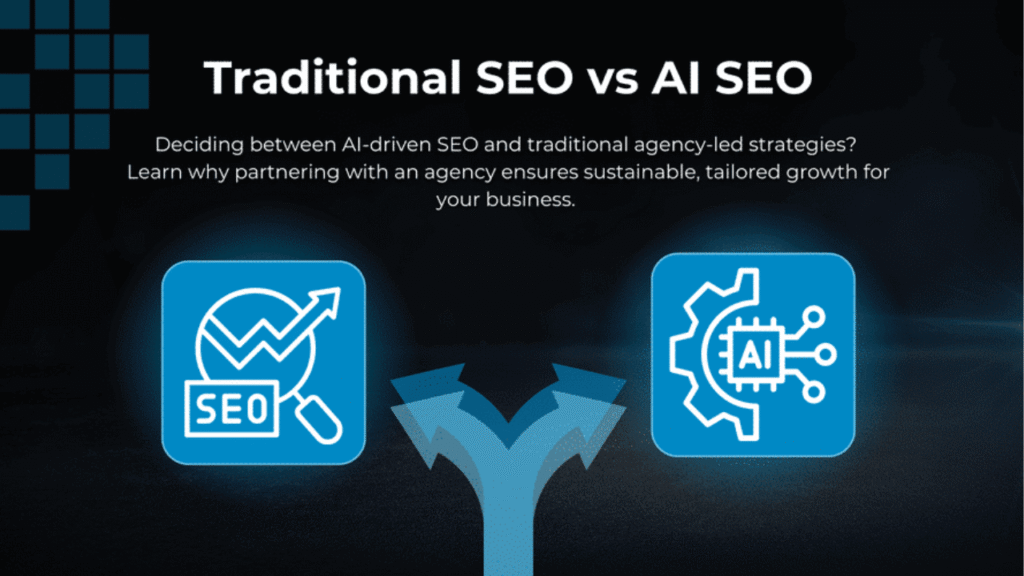
Traditional SEO was keyword focused, requiring hours of manual research. AI SEO prioritizes intent over keywords, understanding what users actually want. What once took afternoons now happens in minutes. Traditional SEO served generic content to everyone, while AI SEO delivers personalized results based on location and behavior.
The biggest shift is from reactive to predictive. AI forecasts trends before they peak, understands context instead of counting keywords, and weighs user experience over backlinks. Yet quality content, E-E-A-T, backlinks, and technical SEO fundamentals still matter just as much.
Why Marketers Need to Care Right Now
Seventy-six percent of marketers already use AI for SEO. Companies using AI tools see forty percent faster content production and two and a half times higher ROI. Fifty three percent of searches now end without a click as users get answers from AI summaries.
Embrace AI SEO now and you’ll discover opportunities competitors miss, create content ten times faster, and dominate featured snippets. Ignore it and competitors will outrank you while your costs increase and results decline.
How to Get Started: Five Practical Steps
Step One: Audit Your Content Use Semrush or Ahrefs to identify underperforming pages and quick wins. Fix technical issues first.
Step Two: Understand Search Intent Analyze “People Also Ask” boxes and use ChatGPT to generate question variations. Identify if users want information or to buy.
Step Three: Answer Real Questions Start with clear answers, use headings as questions, add FAQs, and write conversationally.
Step Four: Optimize for Snippets Answer questions in forty to sixty words, use lists and tables, add schema markup. Target keywords where you rank four through ten.
Step Five: Monitor Continuously Weekly rank tracking, monthly reviews, quarterly adjustments. Spend thirty minutes weekly reviewing performance.
Common Myths About AI SEO: Setting the Record Straight
Myth One: AI Will Write All Your Content
AI can’t replicate original research, personal experience, unique brand voice, or expert analysis. Use AI as your research assistant to speed up ideation and drafting, but add the human touch that makes content memorable.
Myth Two: Traditional SEO Is Dead
The fundamentals haven’t changed quality backlinks, fast loading pages, mobile optimization, clear structure, and authoritative content remain essential. AI enhances traditional SEO; it doesn’t replace it.
Myth Three: You Need to Be a Tech Expert
Modern AI tools are designed for marketers, not developers. No coding required for Semrush, Ahrefs, or Surfer. ChatGPT uses plain English commands. If you can use Google Docs, you can use AI SEO tools.
The Future: What’s Coming Next in AI and SEO
Voice Search Evolution Voice assistants are becoming conversational. People ask follow up questions and expect complete answers. Optimize for natural, spoken queries and comprehensive responses.
Visual Search Advancement Google Lens lets users search with images. Photos of products, landmarks, or objects are instantly identified. Optimize images with descriptive alt text and structured data.
Hyper-Personalized Results Search results will be unique to each person based on behavior and preferences. Create diverse content for different audience segments rather than one size fits all pages.
AI Chatbots in Search ChatGPT and Bard are changing information discovery. Users have conversations instead of typing keywords. Be the authoritative source AI chatbots reference.
Final Thoughts: Embrace AI, But Keep the Human Touch
AI has transformed SEO from keyword-matching to intent-understanding. Google comprehends context and predicts needs. Tools like Semrush, Ahrefs, and Surfer help you research faster and optimize smarter. Traditional fundamentals like quality content and E E A T remain essential AI just helps you execute better.
Remember: AI is your assistant, not your replacement. It handles research and analysis, but cannot replicate your unique experiences, original insights, or authentic connection with your audience. The winning content combines AI efficiency with human expertise.
Your Next Step: Take one action this week. Run an audit, optimize one article, or research keywords with ChatGPT. Each small step builds momentum.
The gap between those embracing AI SEO and those hesitating grows daily. Your competitors aren’t waiting neither should you.