
Winner
Runner
You’re facing a big decision: choosing the right SEO and marketing tool.
Semrush and Ahrefs are both popular options, but which one truly fits your needs?
It’s tough to decide when both promise to improve rankings, simplify content creation, and give you an edge over competitors.
Many marketers, agencies, and business owners struggle with this exact choice.
You need a platform that helps you take action faster, not one that leaves you confused about where to start.
In this article, we’ll compare Semrush vs Ahrefs side by side.
By the end, you’ll know which platform is the best match for your marketing strategy.
Ready to make a confident choice for your business? Let’s get started.
Overview Semrush vs Ahrefs
Semrush and Ahrefs are both powerful options, but which one truly fits your needs?
Ready to make an informed decision for your business? Let’s dive in!
What is Semrush
Semrush is a marketing platform built for SEO, paid search, content marketing, social media management, and competitive intelligence. It’s used by freelancers, in-house marketing teams, and agencies to discover high-value keywords, audit and optimize websites, analyze competitors’ organic and paid strategies, manage backlinks and content workflows, and generate client-ready reports.
Over the years Semrush has grown into a full marketing suite that combines large data indexes (keywords, SERPs, backlinks), automation for recurring monitoring, specialized research tools for markets and competitors, and collaboration/reporting features that agencies and teams need to scale.
Key features of Semrush
Keyword Research & Keyword Magic :massive keyword database with filters for intent, volume, difficulty, SERP features, related keywords and long-tail suggestions; includes keyword grouping and bulk export for content planning.
Position Tracking (Rank Tracking) : daily rank checks across desktop, mobile and local results; visibility and share-of-voice metrics plus alerts for major rank shifts.
Site Audit & Technical SEO : automated site crawling with prioritized issues (crawlability, indexability, Core Web Vitals, structured data, duplicate content, redirect chains) and step-by-step recommendations for fixes.
On-Page & Content Tools :Content Template, SEO Writing Assistant and Topic Research to create SEO-friendly briefs; content scoring against top competitors and optimization tips (keywords, readability, structure).
Backlink Analytics & Link Building :large backlink index for discovery and historical trends, toxic link detection, outreach workflows, link prospect lists and competitor backlink gap analysis.
Advertising & PPC Research :competitor ad examples, historical ad copy, CPC and paid keyword data, campaign planning support and creative insights to improve paid search performance.
Market & Competitive Intelligence : Traffic Analytics and Market Explorer to estimate competitors’ traffic sources, audience interests, top pages, and to benchmark market share and trends.
Local SEO & Listings : local rank tracking, citation management and tools to manage business listings and local visibility.
Social Media Management :schedule and post to multiple social networks, track engagement, and compare social performance across competitors.
Reporting & White-Labeling : custom, automated PDF/online reports, client dashboards, API access and white-label options for agencies.
Pricing
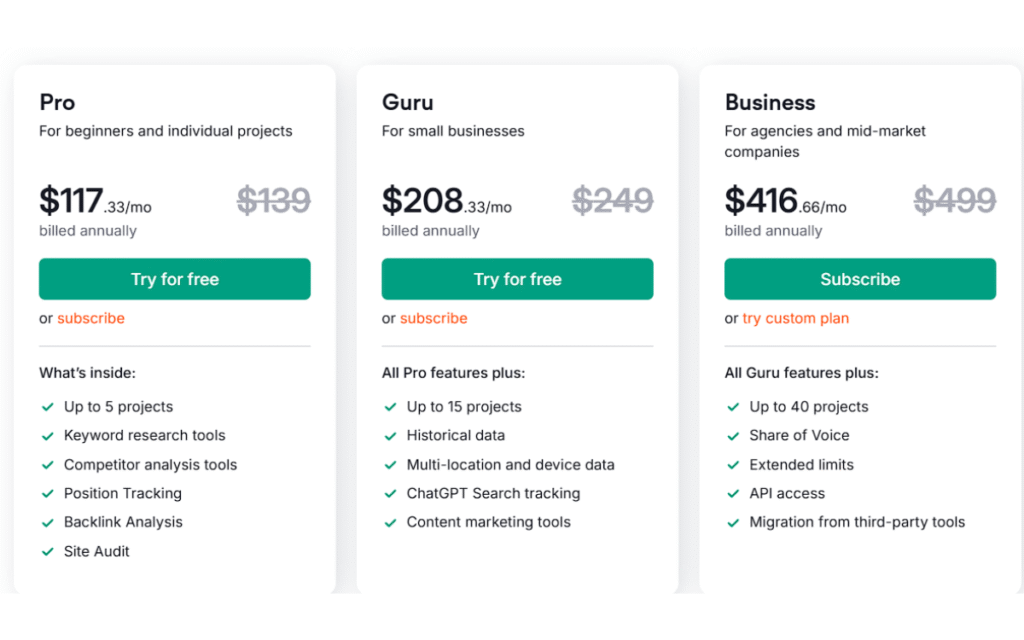
Pro – $139.95/month (annual billed ≈ $117.33/month). Good for freelancers and small teams starting with full SEO + basic content tools.
Guru – $249.95/month (annual billed ≈ $208.33/month). Adds historical data, extended limits and the Content Marketing Platform — aimed at growing agencies and marketing teams.
Business – $499.95/month (annual billed ≈ $416.66/month). For large agencies and enterprises needing high limits, white-labeling, API access and advanced reporting.
Enterprise / Custom — available for very large or specialized needs with custom limits and pricing.
Pros
Cons
What is Ahrefs
Ahrefs is one of the most powerful and widely recognized all in one SEO platforms, trusted by marketers, agencies, content creators, and businesses of all sizes across the globe. At its core, Ahrefs is designed to help users improve search visibility, grow organic traffic, and make smarter content and marketing decisions.
The platform stands out for its industry-leading backlink database, advanced keyword research capabilities, and detailed competitive insights. With Ahrefs, you can track keyword rankings, run site audits, analyze competitors, uncover content gaps, and discover link-building opportunities all from a single dashboard.
What makes Ahrefs especially popular is its accuracy and scale of data. The tool crawls the web almost as actively as Google, giving SEO professionals reliable insights into backlinks, content performance, and keyword opportunities. Because of this, Ahrefs is considered an industry benchmark for serious SEO work, often used to shape strategies for both small websites and enterprise-level projects.
Key Features of Ahrefs
Site Explorer Get in-depth insights into any website’s performance. Analyze organic traffic, uncover the exact keywords a site ranks for, review paid search campaigns, and dive deep into backlink profiles to understand how competitors are building authority.
Keywords Explorer Access millions of keyword ideas with accurate search volume, keyword difficulty, clicks data, and advanced metrics. It supports multiple search engines, including Google, YouTube, Amazon, and Bing, making it versatile for different content strategies.
Site Audit Perform a comprehensive technical SEO audit to identify on page and structural issues like broken links, slow-loading pages, or crawlability problems. Ahrefs gives actionable recommendations to improve site health and overall performance.
Rank Tracker Monitor your keyword positions across different countries, devices, and search engines. Track progress over time, measure visibility against competitors, and receive detailed reports to guide optimization strategies.
Content Explorer Discover the most shared, linked, and high performing content in any niche. Use it to find trending topics, analyze what works in your industry, and generate ideas for content marketing and outreach campaigns.
Backlink Analysis Leverage one of the world’s largest and most up-to-date backlink databases. Identify referring domains, analyze anchor texts, track lost and new links, and uncover link-building opportunities to strengthen authority.
Competitive Research Compare multiple domains side by side to spot content gaps, keyword opportunities, and backlink strategies. This helps you understand competitor strengths and weaknesses while refining your own SEO campaigns.
Pricing for Ahrefs
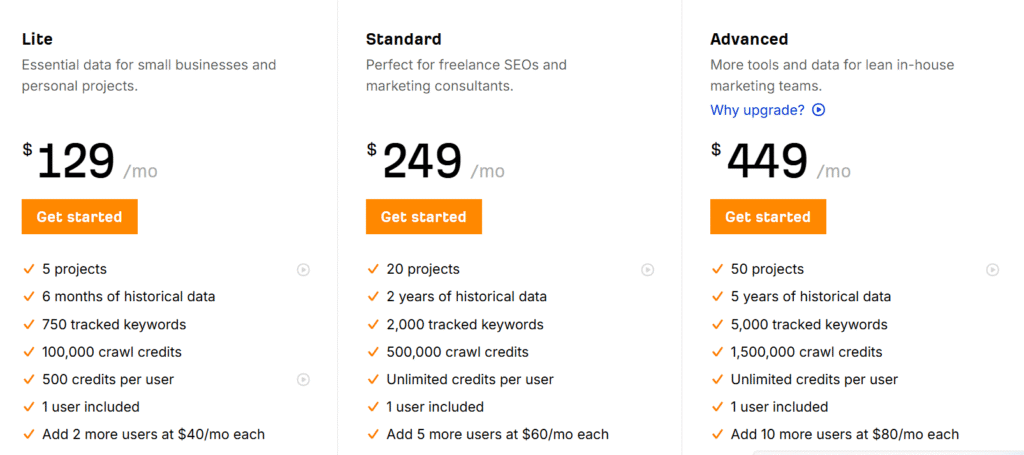
Ahrefs offers four main subscription plans, each designed for different types of users. The Lite plan, starting at around $99 per month or $83 per month when billed annually (about $990 per year), is best suited for small businesses and solo site owners who need access to core SEO tools.
The Standard plan is priced at about $199 per month, or $166 per month on the annual plan (roughly $1,990 per year). It’s a popular choice for freelance SEOs and consultants who require more data, additional projects, and broader keyword tracking capabilities.
For larger teams, the Advanced plan costs around $399 per month, or $333 per month when billed annually (about $3,990 per year). This plan is ideal for in-house marketing teams or agencies that manage multiple websites and need more historical data along with higher usage limits.
At the top tier, the Enterprise plan is priced at approximately $999 per month, or $833 per month on the annual plan (around $9,990 per year). It is designed for large enterprises or agencies with extensive SEO requirements, offering maximum data capacity, project limits, and customization options.
Pros
Cons
Feature Comparison: Semrush vs Ahrefs
When it comes to SEO, two names stand out: Semrush and Ahrefs.
Both are powerful platforms trusted by marketers, agencies, and businesses worldwide.
While they share similar goals boosting rankings, analyzing competitors, and driving growth their strengths lie in different areas. Semrush shines as an all-in-one marketing suite, while Ahrefs dominates in backlink and competitor analysis.
In this comparison, we’ll break down their features side by side to help you choose the right tool for your strategy.
Keyword Research
Semrush: Offers extensive keyword research with advanced filters, keyword intent, SERP features, and competitor keyword gap analysis. Works well for campaign planning, PPC research, and SEO. Comparable to SurferSEO and MarketMuse for building keyword clusters, though not as AI-prompt-driven as AIPRM or SEO GPT. Integrates effectively with content tools for topic ideation and clustering.
Ahrefs: Known for one of the largest and most accurate keyword databases. Provides keyword difficulty, clicks-per-search, traffic potential, and historical trends. Excellent for global keyword analysis and competitive research. Works well with RankIQ or Kiva for competitive targeting but lacks AI-driven clustering like Semrush or SnowSEO.
Content Optimization & Internal Linking
Semrush: Provides strong on-page SEO recommendations, SEO writing assistant, topic research, and content audit features. Offers internal linking recommendations, schema markup, and content scoring, similar to SEOMatic and InLinks. Can integrate with SEO GPT or AIPRM for AI content generation and ideation.
Ahrefs: Strong in content performance analysis and identifying underperforming pages. Provides actionable insights but has limited internal linking automation. Schema markup is not automated. Works best when paired with Zentask, LinkWhisper, or SEO GPT for AI-enhanced execution.
Backlink & Competitor Analysis
Semrush: Offers backlink audits, toxic link detection, link-building tools, and competitor link gap analysis. Its backlink index is robust but not as massive as Ahrefs. Similar to SEOPress or SEOMatic for backlink tracking but enhanced with disavow features and outreach workflows.
Ahrefs: Industry leader in backlink data. Offers one of the largest and freshest link indexes, backlink profiles, anchor text distribution, and link opportunities. Far more extensive than most tools. Comparable to SEOpress or MarketMuse’s link insights but with unmatched depth.
Rank Tracking & Domain Analysis
Semrush: Advanced rank tracking across desktop, mobile, and local results. Tracks SERP features, visibility score, and competitive positioning. Domain analytics include traffic insights, authority scoring, and keyword gap analysis. Semantic features are less AI-driven than InLinks but highly detailed.
Ahrefs: Provides rank tracking with historical trends, domain comparison, keyword positions, and traffic share data. Strong in raw performance metrics but lacks AI-driven semantic scoring. Can be paired with RankIQ or Kiva for AI-assisted tracking and competitive strategy.
Reporting & Customization
Semrush: Offers customizable dashboards, branded reports, and automated SEO audits. Strong integrations with Google Analytics, Search Console, and third-party tools. Similar to MarketMuse for automated reporting, but with broader PPC and SEO campaign visibility. Can integrate with SEO GPT or Zentask for AI-enhanced content workflows.
Ahrefs: Provides comprehensive backlink, traffic, and keyword reports with strong visualization tools. Less automated in content generation but extremely detailed in analytics. Works well with SEOGPT or Zentask for turning reports into actionable AI-guided strategies.
Ease of Use & Scalability
Semrush: Broad toolset covering SEO, PPC, social media, and content marketing. Beginner-friendly with guided workflows but can feel overwhelming with its many features. Suitable for solopreneurs, SMBs, and agencies. Comparable to InLinks in semantic optimization and SEOMatic in structured automation.
Ahrefs: Highly data-rich but has a steeper learning curve. Best for agencies, SEO professionals, and enterprises managing large campaigns. Scales efficiently across projects. Integrates well with tools like RankIQ, Kiva, SEOPress, and LinkWhisper for extended workflows.
What To Look For When Choosing an SEO Platform
Goals: Choose Semrush if you want an all-in-one platform covering keyword research, content optimization, backlink audits, PPC, and rank tracking. Opt for Ahrefs if backlink analysis, competitor insights, and raw SEO metrics are your top priorities.
Budget vs Value: Semrush provides more bundled features (SEO + PPC + social) making it cost-effective for marketers who need an all-rounder. Ahrefs is premium but unmatched in backlink data and pure SEO insights.
Ease of Use vs Depth: Semrush balances automation with usability, great for small to mid-sized teams. Ahrefs offers deeper analytics but comes with a learning curve.
Internal Linking & Schema: Semrush automates internal linking and schema (like LinkWhisper + SEOMatic), while Ahrefs requires pairing with external AI tools for execution.
Scalability: Semrush works for solopreneurs, SMBs, and agencies. Ahrefs is best for professionals, agencies, and enterprises managing multiple high-volume SEO campaigns.
Final Verdict
- Semrush is the better fit if you want an all-in-one platform for keyword research, PPC, content optimization, internal linking, and competitive tracking with some AI support. Ideal for marketers, small businesses, and agencies looking for breadth and automation.
- Ahrefs is the go-to choice for SEO professionals and enterprises that prioritize deep backlink data, accurate keyword metrics, rank tracking, and competitor analysis. Perfect for scaling SEO campaigns at a professional level.
There’s no absolute “winner.” If you value AI automation, schema support, and broader marketing tools → go with Semrush.
If you prioritize raw SEO power, backlink authority, and in-depth competitive insights → choose Ahrefs.
If you’re exploring other SEO automation platforms, don’t miss our detailed comparisons with SnowSEO, AIPRM, MarketMuse, SurferSEO, InLinks, and more.
1 thought on “Semrush vs Ahrefs : Which One Is The BEST SEO TOOL?”
Comments are closed.